Sunday, December 20, 2020

Nellis Air Force Base, Las Vegas, Nevada - Part 2

I will never forget my time at Nellis. I found out in March of 2017 that I would soon be promoted to the rank of Senior Master Sergeant (SMSgt/E-8) with an effective date of rank of 1 June 2017. A huge life adjustment happened at this base as well as we brought into the world a beautiful baby girl on December 18, 2017. To this day, I get her birthday backwards; I was asked at a recent appointment to give her birthday to which I said 12/17/18 – the receptionist smiled and shook her head. I corrected myself with 12/18/17! Our lil Norah Leona Kahealani Watros is our little angel yet has the biggest mischievous spirit! I deployed for a 7th and final time, spending 188 days in Al Udeid Air Base, Qatar from October of 2018 till April of 2019. 


Al Udeid Air Base is a military base southwest of Doha, Qatar. It houses Qatar Air Force, United States Air Force, Royal Air Force, and other Gulf War Coalition personnel and assets. It is host to a forward headquarters of United States Central Command, headquarters of United States Air Forces Central Command, No. 83 Expeditionary Air Group RAF, and the 379th Air Expeditionary Wing of the USAF. In 1999, the then Emir of Qatar, Sheikh Hamad told U.S. officials that he would like to see as many as 10,000 U.S. servicemen permanently stationed at Al Udeid. According to media reports in June 2017, the base hosted over 11,000 U.S. and U.S.-led anti-ISIL coalition forces and over 100 operational aircraft. Al Udeid Air Base now serves as a logistics, command, and basing hub for U.S. operations in Afghanistan and Iraq. Nearby Camp As Sayliyah houses significant U.S. military equipment pre-positioning and command and control facilities for the CENTCOM's area of operations. Both Qatar and the United States have invested in the construction and expansion of these facilities since the mid-1990s, and they form the main hub of the CENTCOM air and ground logistical network in the area of responsibility. As a result of ongoing operations in Iraq and Afghanistan, U.S. and partner nation facilities in Qatar and elsewhere have received higher use in recent years and may require further investment to meet current and potential future needs. We accomplished so many things as a team - I was grateful for this 7th and final deployment and after so many trips to the middle east, I had never been up close and personal with a camel. I FINALLY got to ride a camel!! WIN!


After arriving home in April of 2019, with an approved retirement date already set, I was in out-processing mode once again – this time there would be no assignment coming; reality was setting in that this was the end of my military career – one that would officially end on October 31st, 2019 and span 23 years, 3 months, and 1 day. I am extremely thankful and proud that my mom was able to attend my military retirement. She was the one who set me off on this journey in the United States Air Force when I was a 19 year old kid back in 1996. Here I stood before my flight, my squadron, my children, my parents, my friends, my colleagues, saying my military goodbyes. What an extremely hard day! One of my best friends, Dom Brock, a class mate of mine back to our Ellsworth Elementary days all the way through graduation in our little Michigan town presided over my retirement as he was an Army Warrant Officer. The point where I nearly lost my military bearing was a portion of the ceremony where I was to present a folded flag to a person of my choosing – my mom of course. Her face said it all; as she started crying (she didn’t know that this was part of the ceremony) I knew she was proud of a son who had served for many years. I had taken her along and she had seen nearly every base I had ever been to in person. And at that point, I couldn’t keep it together ether. I was supposed to hand her the flag, salute it and do an about face and walk away. I was able to salute, then gave her a big hug before walking back to my chair. All bearing lost….after what happened just a few months later, it was apparent that that was the best loss of bearing and so very worth it!


So many more memories were made at Nellis – from the birth of a child, our flight being honored as one of the top 3 POL flights in 2017 in ALL of the Air Force, to a new stripe, trips to Disney Land in California and The Grand Canyon in Arizona; learning how to play craps and roulette and enjoying the many hours sitting on a poker table in Las Vegas. Many NASCAR races with my racing buddy, Avery, at Las Vegas Motor Speedway (we lived less than 5 miles away), trips to Hollywood, San Diego, the mountains around Las Vegas, Hoover Dam, Valley of Fire State Park, to buying a new (50 year old) 1970 Chevrolet C-10 I called “The Ghost” (my dad has her in Michigan!), and of course a once in a lifetime military retirement. What an amazing assignment. What a way to end my military career! 


My advice is to never give up on your dreams and don’t ever forget where you came from. I don’t have any secrets as to how I came from a small town in Northern Michigan as a 19 year old kid to that of the crusty old Senior Master Sergeant at 42 in the United States Air Force. I will say this, I’ve never been afraid of hard work. I feel I’ve proved my worth within every organization I’ve been in; I’ve led teams as large as 110 people, but I can still get back and do the basic tasks that we expect of our new Airmen. To me, that’s what this is all about.  

My main goal in sharing this is to leave some sort of legacy for my children at some point. I have a friend who’s now in his 80s; an Army vet who served his country for 30 years. I’d love to hear his story; some day in my life, I’d hope someone would love to hear my story – even if it’s after I’m gone. Through all my time in the military, it’s always been about the people and the relationship and bond between those people. Through my 7 assignments and 7 deployments and 32 TDYs, I must have come across thousands of people, both within in the military and those I knew from elsewhere. I have so many fond memories with so many people. I’m sure I’ve forgotten far more stories than I’ve written, but that’s how it goes sometimes. I truly hope you’ve had a chance to read through all the posts thus far and smiled, laughed, felt my pain at times through my adventures within the Air Force and life that surrounded those. I have been blessed beyond measure. Thank you for all who’ve been in my life thus far. But you know what? The journey didn’t end with me retiring from this great United States Air Force. 


We made it across the finish line - However, the journey continues to this day!! I dedicate this to my beautiful mom who we sadly lost this year. She was there from the beginning until the end of my time in the military. She put me on a bus in 1996 and watched me retire in 2019. She visited me in nearly every place I lived; she worried about me on every deployment I went on. Mom was there for my successes and around when I stumbled as well. She truly was always my rock and my biggest fan throughout this journey. Thank you to an amazing woman. Rest easy Sherry Lynn Watros-Fisher (11 August 1953 - 20 February 2020). Love you always mom! 


A quick recap to my 23 years, 3 months, and 1 day in the Greatest Air Force on Earth!
Boarded a bus in Traverse City, Michigan – 30 July 1996
Boarded a plane in Detroit, Michigan; landed in San Antonio, Texas – 31 July 1996
The Journey Starts – Lackland Air Force Base, San Antonio, Texas – 31 July – 16 Sept 1996
Tech School – Sheppard Air Force Base, Wichita Falls, Texas – 17 Sept – 4 Nov 1996
Recruiters Assistance Program/Leave – Traverse City, Michigan - 5 Nov – 26 Nov 1996
1st Assignment – Seymour Johnson AFB, Goldsboro, North Carolina – 27 Nov 1996 to 21 May 2000
2nd Assignment – Aviano Air Base, Aviano, Italy – 22 May 2000 to 7 May 2004
3rd Assignment – Grand Forks AFB, Grand Forks, North Dakota – 8 May 2004 to 23 May 2009
4th Assignment – Eielson AFB, Fairbanks, Alaska – 24 May 2009 to 4 June 2013
5th Assignment – Seymour Johnson AFB, Goldsboro, North Carolina – 5 June 2013 to 5 Oct 2015
6th Assignment – Daegu AB, Daegu, South Korea – 6 Oct 2015 to 22 Nov 2016
7th Assignment – Nellis AFB, Las Vegas, Nevada – 23 Nov 2016 to 31 Oct 2019 (RETIRED)

Major Deployments
1- Prince Sultan AB, Al Kharj, Saudi Arabia – 1998 for 129 days supporting Operation Southern Watch
2 - Prince Sultan AB, Al Kharj, Saudi Arabia – 2002/2003 for 147 days supporting Operation Southern Watch
3 - Diego Garcia AB, British Indian Ocean Territory – 2005 for 138 days supporting Operation Enduring Freedom
4 - Manas AB, Kyrgyzstan – 2008 for 124 days supporting Operation Enduring Freedom
5 - Ali AB (Talil), Nasiriyah, Iraq – 2010 for 198 days supporting Operation Iraqi Freedom
6 - Isa AB, Manama, Bahrain – 2012 for 180 days supporting Operation Enduring Freedom
7 - Al Udeid AB, Qatar - 2018/2019 for 192 days supporting Operation Operations Inherent Resolve and Freedom's Sentinel

Monday, December 14, 2020

Nellis Air Force Base, Las Vegas, Nevada - Part 1


After driving across North Carolina, Tennessee, Arkansas, Oklahoma, Texas, New Mexico, Arizona, and into Nevada– we finally, finally arrived at Nellis in early December 2016 – what would end up being my final military assignment. 2,400 miles and what’s supposed to be a 35 hour drive; I can tell you this, Tennessee is a long, long state!!!  

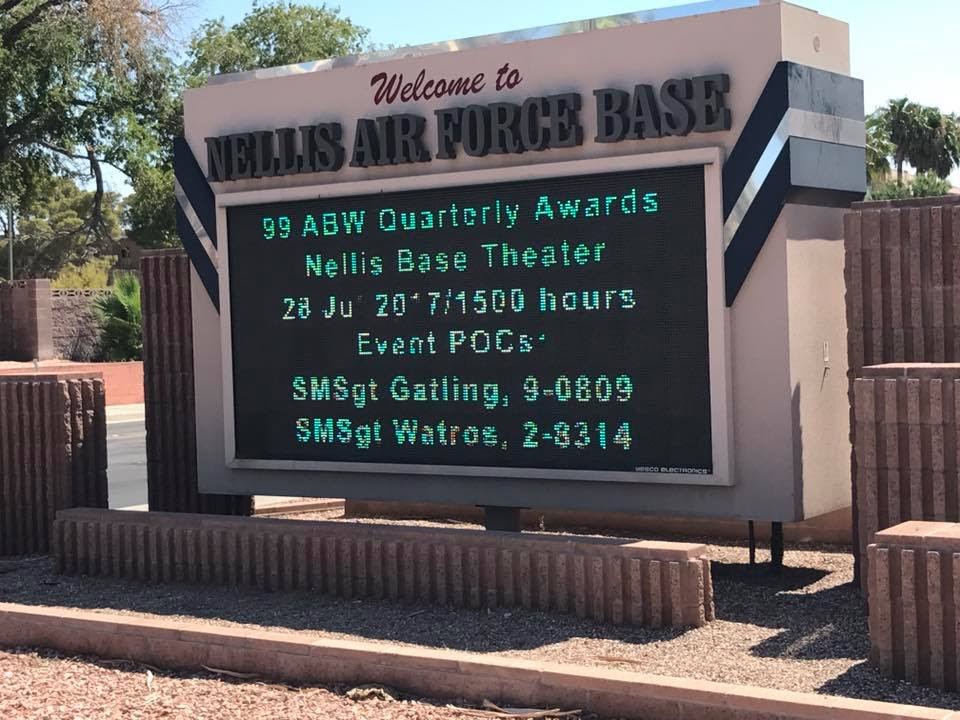
We signed into Nellis Air Force Base just outside of Las Vegas with a feeling that this may be the last stop of our military journey.  Not knowing what would be next or how long we’d stay but that would become clearer as the first year progressed.  I’ve loved the historical aspect of every base that I’ve been so we’ll start there.  Except with Nellis, I’m going to stick with two big aspects; Red Flag and the world famous Thunderbirds!

Red Flag is the U.S. Air Force's premier air-to-air combat training exercise. Participants often include both United States and allied nations' combat air forces. The exercise provides aircrews the experience of multiple, intensive air combat sorties in the safety of a training environment. First held in 1975, Red Flag exercises bring together aircrews from the United States Air Force (USAF), United States Navy (USN), United States Marine Corps (USMC), United States Army (USA) and numerous NATO and allied nations' air forces. The origin of Red Flag was the unacceptable performance of U.S. Air Force fighter pilots and weapon systems officers in air-to-air combat during the Vietnam War in comparison to previous wars. Air combat over North Vietnam between 1965 and 1973 led to an overall exchange ratio (ratio of enemy aircraft shot down to the number of own aircraft lost to enemy fighters) of 2.2:1 (for a while in June and July 1972 during Operation Linebacker the ratio was less than 1:1).

An Air Force analysis known as Project Red Baron II showed that a pilot's chances of survival in combat dramatically increased after he had completed ten combat missions. As a result, Red Flag was created in 1975 to offer USAF pilots and weapon systems officers the opportunity to fly ten realistically simulated combat missions in a safe training environment with measurable results. Many U.S. aircrews had also fallen victim to Surface-to-Air missiles during the Vietnam War, and Red Flag exercises provided pilots and weapon systems officer’s experience in this regime as well.

Today, the 414th Combat Training Squadron (414 CTS) is the unit currently tasked with running Red Flag exercises, while the 64th Aggressor Squadron (64 AGRS) also based at Nellis AFB uses F-16 aircraft to emulate the MiG-29 Fulcrum. These aircraft continue to be painted in the various camouflage schemes of potential adversaries. An additional squadron at Nellis, the 65th Aggressor Squadron (65 AGRS), operated F-15 aircraft in various camouflage schemes of potential adversaries to replicate Su-27 Flanker and Su-35 Flanker threats. However, the 65 AGRS was inactivated on September 26th, 2014 due to the Fiscal Year 2015 budget constraints imposed upon the Air Force that zero-lined the squadron's budget.

One major incident that happened while I was stationed at Nellis happened on January 29th, 2018. Right before Red Flag, a Royal Australian Air Force (RAAF) Boeing EA-18G Growler burst into flames and skidded off the runway. A RAAF investigation concluded that one of the electronic warfare aircraft's General Electric F414 turbofan engines experienced an uncontained catastrophic failure. Both crew were relatively unharmed, but it left a mess to clean up at the end of the runway, that’s for sure!

Red Flag exercises were an aspect that bonded me with a previous assignment.  While I was stationed at Eielson, we had the same sort of exercises, called Red Flag-Alaska.  I truly loved how my experiences in one location often translated to an overall understanding to the mission at a completely different base in a completely different position.  While in Alaska, I had started out as a fuels controller, worked in our refueling maintenance section, and worked my way up into a FISC position.  Here at Nellis, I started out as the Distribution Section Chief and would find myself as the Fuels Superintendent at this busy, busy base!

The USAF Air Demonstration Squadron is the air demonstration squadron of the United States Air Force known worldwide as The Thunderbirds. The Thunderbirds are assigned to the 57th Wing, and are based at Nellis Air Force Base, Nevada. Created in 1953, the USAF Thunderbirds are the third-oldest formal flying aerobatic team in the world, after the French Air Force Patrouille de France formed in 1931 and the United States Navy Blue Angels formed in 1946. The Thunderbirds Squadron tours the United States and much of the world, performing aerobatic formation and solo flying in specially marked aircraft. The squadron's name is taken from the legendary creature that appears in the mythologies of several indigenous North American cultures.

From the end of the runway the four-ship Thunderbird team get ready to begin their takeoff roll with the words "Thunderbirds, let's run em up!" being retransmitted from the team leader's mic through the PA system for the crowd to hear.

Diamond: Historically, as Thunderbirds 1 through 4 lift off, the slot aircraft slips immediately into position behind 1 to create the signature Diamond formation. Thanks to the 2009 upgrade to the Block 52, the Diamond now has more than enough thrust to continue to climb straight up into their first maneuver, the Diamond Loop.

Solos: Thunderbird 5 takes to the air next, performing a clean low altitude aileron roll, followed by 6 who performs a split S, climbing in a near vertical maneuver, rolling over and diving back toward show center and pulling up just above the runway to exit in the opposite direction.

Much of the Thunderbirds' display alternates between maneuvers performed by the diamond, and those performed by the solos. They have a total of eight different formations: The Diamond, Delta, Stinger, Arrowhead, Line-Abreast, Trail, Echelon and the Five Card. The Arrowhead involves maneuvers in tight formation with as little as 18 inches (46 cm) fuselage to canopy separation. They perform formation loops and rolls or transitions from one formation to another. All maneuvers are performed at speeds of 450 to 500 mph.

The opposing solos usually perform their maneuvers just under the speed of sound (500 to 700 mph) and show off the capabilities of their individual aircraft by doing maneuvers such as fast passes, slow passes, fast rolls, slow rolls, and very tight turns. Some of their maneuvers include both solo aircraft at once, such as opposing passes (passing in close proximity to each other) and mirror formations (two aircraft being flown back-to-back in the calypso pass or belly-to-belly). In mirror formations, one Thunderbird must be inverted, and it is always number 5. In fact, the number 5 on this aircraft is painted upside-down, and thus appears right-side-up for much of the routine. There is also an extra amount of humor regarding the inverted performance of Thunderbird 5: the pilots all wear tailored flight suits with their name and jet number embroidered on the left breast. The suit for the pilot of the number 5 airplane has the number sewn upside-down.

Nearing the end the Diamond pulls straight up into the vertical to perform the signature "Bomb Burst," where all four aircraft break off in separate directions while a solo goes straight up through the maneuver and performs aileron rolls until three miles above the ground. At the end of the routine, all six aircraft join in formation, forming the Delta.

One of the Thunderbirds' standing engagements is the annual commencement ceremony at the United States Air Force Academy in Colorado Springs. The jets fly over Falcon Stadium at the precise moment the cadets throw their hats into the air at ceremony's end.

The first plane used by the Thunderbirds was the straight-wing F-84G Thunderjet. Because the Thunderjet was a single-seat fighter, a two-seat T-33 Shooting Star served as the narrator's aircraft and was used as the VIP/Press ride aircraft. The T-33 served with the Thunderbirds in this capacity in the 1950s and 1960s. In the spring of 1955, they moved to the swept-wing F-84F Thunderstreak aircraft, in which they performed 91 air shows, and received their first assigned support aircraft, a C-119 Flying Boxcar. The Thunderbirds' aircraft were again changed in June 1956, to the F-100C Super Sabre, which gave the team supersonic capability. For a time, if the show's sponsor permitted it, the pilots would create a sonic boom; this ended when the FAA banned supersonic flight over the continental United States. The team switched to the F-105 Thunderchief for the 1964 season, but were forced to re-equip with the F-100D after only six airshows due to a catastrophic structural failure of the No. 2 aircraft during a pitch-up maneuver that resulted in the death of Capt Gene Devlin at Hamilton Air Force Base. The F-100D Super Sabre was retained through the 1968 season. By 1967, the Thunderbirds had flown 1,000 shows. In 1969, the squadron re-equipped with the front-line F-4E Phantom, which it flew until 1973, the only time the Thunderbirds would fly jets similar to those of the Blue Angels as it was the standard fighter for both services in the 1960s and 1970s. Due to the 1973 oil crisis, the team flew only six air shows and was grounded for some time. However, in 1974 they switched to the more economical T-38 Talon. Five T-38s used the same amount of fuel needed for one F-4 Phantom. The switch to the T-38 also saw an alteration of the flight routine to exhibit the aircraft's maneuverability in tight turns, and also ended the era of the black tail on the No. 4 slot plane, which would now be regularly cleaned and shined like the others. n 1982, the Thunderbirds suffered a catastrophic loss during pre-season training on 18 January.[1] While practicing the four-plane diamond loop, the formation impacted the ground at high speed, instantly killing all four pilots: Major Norman L. Lowry (commander/leader), Captain Willie Mays, Captain Joseph N. "Pete" Peterson, and Captain Mark Melancon. The cause of the crash was determined by the USAF to be the result of a mechanical problem with the No. 1 aircraft's control stick actuator. This resulted in insufficient back pressure by the formation leader on the T-38 control stick during the loop. Visually cueing off of the lead aircraft during formation maneuvering, the wing and slot pilots disregarded their positions relative to the ground. The team's activities were suspended for six months pending investigation of the crashes and review of the program, then reinstituted using the General Dynamics F-16A Fighting Falcon in 1983 and were upgraded to the F-16C (now produced by Lockheed Martin) in 1992, the aircraft that they still fly to this day! The Thunderbirds have performed at over 4,000 airshows worldwide, accumulating millions of miles in hundreds of different airframes over the course of their more than fifty-four years of service. Flying high-performance fighter jets is inherently dangerous; when flying in extremely close formation, the danger is compounded. In total, twenty-one Thunderbirds pilots have been killed in the team's history. Only three fatal crashes have occurred during air shows. 

My time just before arriving and while at Nellis saw an unfortunate string of Thunderbird accidents:

2 June 2016: Major Alex Turner, flying Thunderbird No. 6, crashed in a field near Colorado Springs, Colorado after performing a flyover at the United States Air Force Academy graduation ceremony. The F-16 pilot ejected and was unhurt. Investigation revealed that the aircraft's engine was inadvertently shut down at the start of landing procedures when a faulty throttle trigger permitted the throttle to be rotated into an engine cut-off position. In a strange twist later that day, the Thunderbirds' Naval counterparts in the Blue Angels suffered a fatal crash of their own.

    23 June 2017: Capt. Erik Gonsalves was injured when, during landing, Thunderbird No. 8 ran off the runway and overturned prior to the Vectren Dayton Air Show. The pilot and a passenger, Technical Sgt. Kenneth Cordova, were trapped in the aircraft for over an hour. Cordova was uninjured. The investigation revealed excessive air speed coupled with landing too far down a wet runway caused the jet to leave the airstrip and flip over. Rain on the canopy windscreen and failure to follow proper braking procedures during the landing contributed to the accident.

    4 April 2018: Maj Stephen Del Bagno, slot pilot, was killed when his aircraft, Thunderbird No. 4, crashed over the Nevada Test and Training Range, during a routine aerial demonstration training flight. Del Bagno, along with five other elite Thunderbird pilots, was practicing an aerial maneuver called the High Bomb Burst Rejoin, and flew inverted for about 22 seconds at about 5,500 to 5,700 feet above ground level, where he experienced up to negative two G-forces. He then started a descending half-loop maneuver called the Split-S, reaching a maximum of 8.56 Gs after five seconds. The extreme G-forces caused him to lose consciousness and be absolutely incapacitated for the next five seconds. About a second before hitting the ground he recovered somewhat and started trying to recover his F-16CM, but it was too late. He did not attempt to eject. Del Bagno, whose call sign was “Cajun,” was an experienced F-35 pilot, whose love of flying, enthusiasm and excitement for his first season with the Thunderbirds was apparent to all. In a January video documenting the moment he and other newly minted Thunderbirds received their iconic red flight helmets, Del Bagno called it “a fantastic day.”

If you ever have a chance to visit Las Vegas, a trip to the Thunderbirds museum, though small, is a must! The Air Force maintains a Thunderbirds Museum covering the history of the demonstration team. The museum is located at Nellis Air Force Base and includes a full size F-16 "Gate Guard" on display (in full Thunderbird paint scheme).

To be continued…….


Monday, December 7, 2020

Daegu Air Base, Daegu, Republic of Korea - Part 2

Daegu (Korean: 대구) literally  means 'large hill', formerly spelled Taegu and officially known as the Daegu Metropolitan City, is a city in South Korea, the fourth-largest after Seoul, Busan and Incheon, with over 2.5 million residents. In the middle of the city, you can climb Mt. Palgongsan in the Apsan mountain range to get an amazing bird’s eye view of this huge city! The Samsung Lions are a South Korean professional baseball team founded in 1982 based in Daegu. Their home stadium is Daegu Samsung Lions Park. They have won the Korean Series eight times. The Samsung Lions is the first team to win four consecutive Korean Series titles (2011, 2012, 2013, 2014) and are also the first Korean team ever to win a regular league title for five consecutive years (2011, 2012, 2013, 2014, 2015). If you’ve never been to a Korean baseball game, it is truly a must when visiting this country.


Though South Korea is a very beautiful and modern country, continual acts of aggression by the North and the simulation of invasion exercises carried on in the south are reminders that the tension between the two countries are still very much alive.  The Korean War was among the most destructive conflicts of the modern era, with approximately 3 million war fatalities and a larger proportional civilian death toll than World War II or the Vietnam War. It experienced the destruction of virtually all of Korea's major cities, thousands of massacres by both sides, including the mass killing of tens of thousands of suspected communists by the South Korean government, and the torture and starvation of prisoners of war by the North Korean military. The Korean War has been called “the Forgotten War” in the United States, where coverage of the 1950s conflict was censored and its memory decades later is often overshadowed by World War II and the Vietnam War. However, since neither North nor South Korea had achieved its goal: the destruction of the opposing regime and reunification of the divided peninsula, this war still continues to this day.  It’s said that North and South Korean generals are still fighting this war; for them it has never ended.

I had a great time in Korea.  The night life was amazing – Thursday Party and Kikis were our places to go on any given evening.  If you wanted a cheap bottom shelf drink in a bag – Kiki’s was the place to go! Good food abound with Etoh’s Pizza in Daegu; a restaurant in Gwangju owned by a Canadian called First Alley Way, great beer at a brewery in Busan called Galmegi and of course you could never get enough Korean BBQ and what I like to call “conveyer belt sushi joints.” Oh, and Koreans love their chicken – eating and drinking chimaek (chicken and beer) and somaek (soju and beer) was an amazing aspect of this assignment! “Kam-sa-ham-ni-da” - thank you or getting in a cab and stating to the driver “pali-pali” – he’d get you there fast - were some basic phrases that one should know when going to South Korea! 


Much of my off duty time was spent running once again.  I ran races of various lengths from 5Ks to Half Marathons all over the country.  I ran in Daegu, Osan, Yeosu, and even an event called The DMZ International Peace Marathon in Cheorwon which sits directly south of the North Korean/South Korean border.  I ran races that were sponsored by military bases across the peninsula (both Air Force and Army), Korea’s National Marathon Association, and even the Korea Radioactive Waste Agency! One race I had signed up for – I spent the night in Gwangju – only to find out the next morning as I’m getting ready that the race was actually in a city called Gyeongju, some 135 miles apart from each other.  Needless to say, I didn’t make that race!


The people of South Korea – I always stated that the people of this country were the nicest, most charitable people that I’ve ever met.  That is – until you put them behind the steering wheel of a moving vehicle!!  I had a scary accident while in South Korea – I had proceeded through an intersection up near Osan Air Base and was broadsided by a Korean driver who ran a stop sign. This would be the first time that I would get a ride in the back of a police car!  Once everything was sorted out, it was found that the other driver was at fault due to the cameras that they have EVERYWHERE in that country.  I was actually surprised, because most places I’ve been, if an American gets into an accident –the American is at fault!  I still apologize to Senior Mike Ostrander from AFPET for totaling his rental while visiting us!

The people is what made this tour amazing – just to name a few that I worked closely with Chief Sigstad, Senior Sheridan, MSgt Bayse at 7th AF, Senior Killen and Senior Dobbertin at Osan Air Base, Senior Northington at Kunsan Air Base, Senior Noel, Senior Brancato, MSgt Sarten, MSgt Collins, MSgt Holloway, TSgt Northrup and TSgt Moore who I worked with at Daegu at various times throughout my year there.  And if you've ever been to Daegu oh in the last 30 years - you know how amazing Mr. Kim is! I think we set future rotations of Airmen up for success from our specific locations throughout the Korean peninsula and am truly thankful for their mentorship and friendship through the years that would follow.  And I can’t forget friends that I talk to even to this day; Adam, JD, Heidi, Sunny, Harry, Mike, Jessica, Meisha, Brandon, and many others who kept me sane during this assignment - thank you all! 

I had some of my most challenging moments in the military during this assignment, but also some of the most rewarding work that I had done up to this point in my military career.  I managed the inspection and maintenance of 345 Fuels Support Equipment assets, 88 facilities and 61 fuel trucks worth $269M with a team of 13 personnel.  A couple awesome achievements we had as a team on this tour in Korea was that we negotiated and oversaw the first-ever Republic of Korea Air Force (ROKAF)/USAF fuel pipeline shipment into Daegu with a receipt of 4 million gallons of jet fuel valued at 7.5 million dollars. In addition to that we worked with our ROKAF partners to hold a joint forces POL exercise with 35 military members from both the United States and South Korea, where we tested our war-time fuel operations and capabilities.  This was a great learning and bonding experience over a couple days working together with another country’s POL troops.  On a personal achievement note; I was ranked as the 3rd out of 54 Master Sergeants that were assigned to 7th Air Force in South Korea that year.  As stated, a challenging, yet amazing year!  So, so much more during that short year; all the driving around the country for both work and play, a trip to Disney World in Florida during my mid-tour, 17 tdy’s from October 30th, 2015 to October 20th, 2016 - totaling 63 days (the largest number of trips away from my duty station from any assignment I have ever had) and my first earthquake!!!  It was a great year of working hard, playing harder, running, flying, driving, and ground shaking!  I wouldn’t have wanted it any other way!


I left South Korea in November of 2016 and got home to my family in North Carolina the day before Thanksgiving.  From there, we packed up once again and started driving west to our new assignment – Nellis Air Force Base in Las Vegas, Nevada.  One last assignment on this amazing career, and the journey certainly continued……..


Until next time Korea!


Monday, November 30, 2020

Daegu Air Base, Daegu, Republic of Korea - Part 1


After a LONG trip around the world, I landed in Daegu, South Korea some 20 hours after I left North Carolina on October 6th, 2015.  My co-workers (all 5 of them) were waiting for me at the airport, loaded me and my bags up and drove the last 10 minutes to the place I would call home for the next year.  The one thing that I absolutely loved there, we were such a small presence, we would meet our new arrivals at the airport just as they had done for me.  That was an amazing aspect of this small, close-knit POL family that we had there!  I found myself at the forefront of this little shop with a huge mission.  I was assigned to the 607th MMS (Material Maintenance Squadron) where our motto was “Just Turn the Key.” 

We all lived in Daegu but also were the caretakers of 3 additional bases spread all over the Korean peninsula with bases in Daegu, Busan, Suwon, and Gwangju.  All 4 bases were in a standby caretaker status but would be very vital to the United States if a conflict were to ever break out again between North and South Korea.  We had contractors on each of the bases and we would spend time at each site for a few days each month to make sure the bases could be opened up at a moment’s notice if and whenever necessary.  The 607th Materiel Maintenance Squadron maintains assets across these four co-located operating bases (Daegu, Gimhae, Gwangju and Suwon) and oversees the reception and bed-down of outside units to these locations. One thing won’t change. In wartime, it would still be the Airmen of the 607
th MMS who would get each of the bases ramped up for war — unlocking and organizing the ammunition, fuel, medical supplies, vehicles, forklifts and other equipment needed to set up a combat air base.

The United States has engaged in four military occupations after World War II and the one in Korea was both the shortest and by most accounts, the least successful. At the end of WWII, the country of Korea was divided in 1948 at the 38th Parallel, with backing from the US sponsored ROK in the south and the Soviet-sponsored Democratic People’s Republic of Korea (DPRK) in the north. The Korean War started on June 25th, 1950 when North Korea invaded South Korea. It ended unofficially on July 27th, 1953 in an armistice. The agreement created the Korean Demilitarized Zone (DMZ) to separate North and South Korea, and allowed the return of prisoners. However, no peace treaty was ever signed, and the two Koreas are technically still at war, engaged in a frozen conflict. To this day, the leaders of North and South Korea are still in an on again/off again process to work toward a treaty and formally end the Korean War. A little Korean War history about each of the bases that we maintained:

Daegu - At the outbreak of the Korean War, the airfield consisted of a dirt and gravel runway and two concrete buildings. The airfield was designated by the USAF as K-2. The airfield was used as part of the Bout One project, an emergency program to train Republic of Korea Air Force pilots to fly the F-51 Mustang. The Bout One planes provided close air support to the U.S. 24th Infantry Division through July 1950. On 10 July 1950, the Bout One force was re-designated as the 51st Fighter Squadron and was merged into the 12th Fighter-Bomber Squadron on August 4th. Taegu Airfield was abandoned following the North Korean attack on Taegu in mid-August 1950, but USAF units began reoccupying the base by September 23rd, 1950.


Suwon - This base was originally established during the Korean War as Suwon (K-13) Air Base and hosted United States Air Force units. The base was evacuated on the night of June 30th, 1950 in the face of the Korean People's Army (KPA) attack, but the base was not occupied by the KPA until July 2nd, 1950. The base was recaptured on September 24th, 1950; the base was again evacuated in the face of the Chinese Third Phase Campaign on January 5th, 1951 and the base's buildings were destroyed. The base was recaptured on January 28th as part of Operation Thunderbolt and by March 6th, despite its poor condition, the base was used for the staging of F-86 patrols along the Yalu River and Mig Alley.

Gwangju - Though I haven’t been able to find much Korean War history pertaining to this base, Gwangju (K-7) is 150 miles south of Seoul. It was an active-duty US Air Force base until the ownership of it was turned over to the Republic of Korea in 1991. The ROK subsequently used the airfield as a base and airport in Kwang Ju City, the 5th largest city in the South Korea. The US Air Force continued to maintain nearly 250 acres of the base. The continued US presence was part of the potential forward deployment of US military personnel and equipment in a wartime scenario. In peacetime the base is normally used for training by South Korean Air Force units and US Air Force units on a regular basis.

Gimhae - The base was originally established during the Korean War as Pusan West (K-1) Air Base and hosted United States Air Force and United States Marine Corps units. On June 25th, 1950, 10 divisions of the North Korean People's Army attacked the Republic of Korea. The North Koreans quickly overwhelmed the South Korean Army and moved south. On June 30th, 1950 C-54s of the Fifth Air Force began transporting a battalion of the 24th Infantry Division from Itazuke Air Base to K-1, however the weight of the C-54s damaged the runway and later flights were made using C-47s. By April 1951 K-1 served as the headquarters of the First Marine Air Wing and Marine Aircraft Group 12 was based at K-1 to provide aircraft for combat missions and special missions.

To be continued……..

Tuesday, November 24, 2020

Seymour Johnson Air Force Base, Goldsboro, North Carolina - 2nd time here!


I would find myself back at Seymour Johnson Air Force Base in Goldsboro, North Carolina the beginning of June 2013.  If you’ve been with me since my earlier posts, you’ll remember that I left this North Carolina base the end of May in 2000.  So here I am, back where it all started some 17 years later after having left 13 years prior.  I arrived the first time as an Airman Basic (E-1), left as a Senior Airman (E-4), and now here I am all these years later back at SJAFB as a Master Sergeant (E-7).  I thought that this may be it, I may just finish my career where I started it all these years ago in 1996.  But, there were other plans in play, plans that I wouldn’t see coming for another two years.  Let’s recap on some quick history about this base. This was my 1st military assignment; I was here from 27 November 1996 to 21 May 2000 on that first tour.  This is where I learned my trade; I refueled my first aircraft, an F-15E Eagle at this base.  I still believe this is the best fighter jet in the world.  It will always have a special place in my heart! 

Seymour Johnson Air Force Base was established five months after the United States entered World War II when the War Department approved the establishment of a technical school two miles southeast of Goldsboro, North Carolina. Seymour Johnson Field was activated on June 12th, 1942, as Headquarters, Technical School, Army Air Forces Technical Training Command. The base is named in honor of U.S. Navy Lt. Seymour A. Johnson, a native of Goldsboro. Johnson, a test pilot, was killed in an aircraft crash near Norbeck, Md., March 5th, 1941. Seymour Johnson Field was deactivated in May 1946. The base was reactivated as a Tactical Air Command base on April 1st 1956 and has been home to B-52 bombers, KC-10 tankers from Strategic Air Command and F-4 and F-16 fighters from the Michigan Air National Guard. “Shady-J” is now the home of the 4th Fighter Wing, known as the Fourth but First, along with the 916th Air Refueling Wing flying the mighty F-15E Strike Eagles and KC-135 Stratotankers.


Honestly, I loved every minute of being back in North Carolina.  I loved interacting with the troops; I loved my off on and off duty time on my second tour here.  It was here that I was stationed, when I married my beautiful wife, Marilyn in October of 2013, not much longer after getting back to this little base!  In an instant, I would become a father to a little girl who I still adore to this day, Avery.  But as you’ll see later and as most of you already know, it wasn’t the last child for us!  But that’s still a couple bases down the road – we’ll get there I promise!!  We got married in Oklahoma City that October and she soon moved out east with me after our honey moon.

During my time here, we spent some time traveling, over to the coast to see where the Wright Brothers first took flight at Kitty Hawk, down to Myrtle Beach in South Carolina, even on an amazing retreat weekend in the mountains of western North Carolina.  We went to NASCAR races in Darlington and Charlotte and caught a practice at Talladega; visited Elvis Presley’s Graceland, volunteered time at airshows, and college football games, and even went to a hot air balloon festival.  We ocean fished on a pier on the Atlantic Ocean, went deep sea fishing, visited the USS North Carolina battleship that’s now a museum, had a great time at an Air Force Combat Dining In, went zip lining – a first for both of us, and enjoyed a great evening at an Air Force Ball with my sweet wife.  One can’t stay in a state like North Carolina and not try NC style, vinegar based bbq either.  To this day, NC bbq is my favorite, hands down!  One huge accomplishment that I had always wanted to do was run and complete the Air Force Marathon up at Wright Patterson Air Force Base in Ohio.  I trained as hard as I thought I needed with a goal in mind of a 4 hour 30 minute marathon.  What I wasn’t prepared for were the hills, and the raining weather that Ohio had in store for this Michigan boy in that late September 2015 run!  I’m still proud to say that I finished in 5 hours, 12 minutes, and 29 seconds!  I ran quite a few other great runs while stationed in North Carolina as well; Run For The Fallen, a color race(won’t do that again), Fire Cracker 4 Miler, and The 15th Annual Oklahoma City Memorial Half, just to name a few.  I’ll have to make a post once I chronicled all of my bases for the races that I’ve ran and have been important to me.  That said, the Air Force Marathon wasn’t my first full distance marathon; I ran the Boston Marathon in 2010!  I finished that race in 5 hours and 36 minutes.  Ok, ok it wasn’t the real Boston Marathon– even better, it was a shadow race that I ran while deployed to Iraq!  But…..I finished Boston!  And now I can always state that I ran and finished the Air Force Marathon as well.  There are a few others I’d like to run, but as stated – I’ll leave those for another post all together!


I hope this was as enjoyable for you to read as it was for me to go through and remember all that we did on this second tour at Seymour Johnson.  I might add; we did all of this and probably much more in a span of just over two years. I received set of orders for my first official short tour (I was credited a short tour for my 7 month tour in Iraq in 2010).  See, I told you there were other plans. I’d be off to Osan Air Base, South Korea.  Well, that is until about 3 weeks prior to leaving – it was changed last moment to Daegu, South Korea.  “Needs of the Air Force” and it became one of my most challenging yet rewarding assignments – even though it was only a yearlong tour.  I left Seymour Johnson on 5 October 2015 (a day after my second wedding anniversary) for my next adventure to South Korea.  In total, I spent 5 years, 9 months, and 26 days in North Carolina between the two trips there.  This would prove to be the longest I spent at one location in my 23+ year Air Force career! The journey continues…….


Happy New Year 2022

Where do I start with summarizing the entirety of 2021? The last post I wrote here on my blog was at the end of 2020 and for a new beginning...